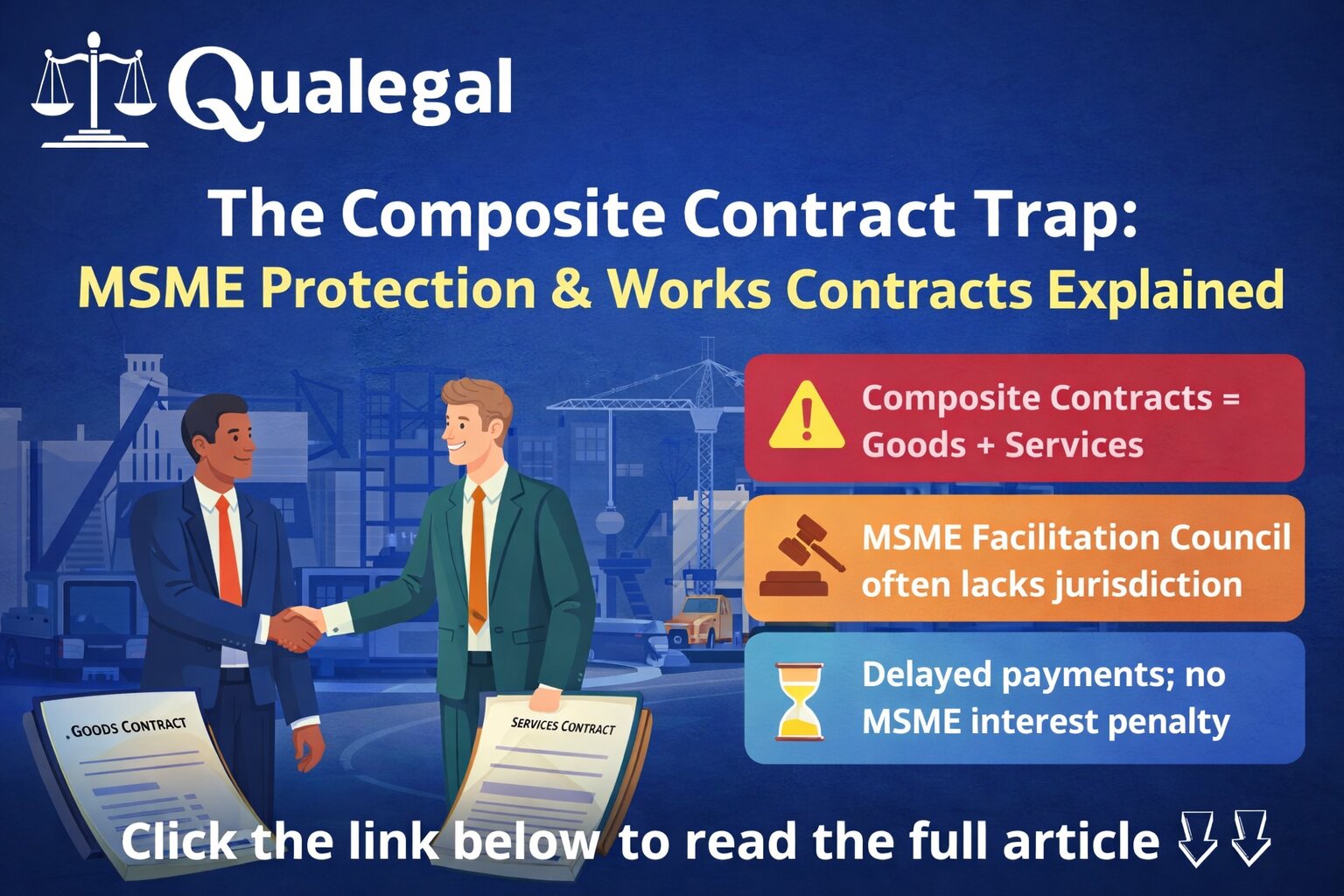
THE COMPOSITE CONTRACT TRAP: WHY ‘GOODS + SERVICES’ AGREEMENTS OFTEN LACK MSME PROTECTION
The Micro, Small and Medium Enterprises Development (MSMED) Act, 2006, was envisioned as a robust protective framework for smaller entities, primarily through its stringent mechanism for recovering delayed payments. By providing for mandatory conciliation and arbitration, alongside the right to compound interest at three times the bank rate, the Act sought to level the playing field between small suppliers and large corporate or governmental buyers. However, a significant legal wall has emerged, where the contract involved is not a simple transaction but a composite works arrangement. As the business landscape evolves toward integrated project delivery, the question of whether a works contract falls within the ambit of Sections 15-18 of the MSMED Act has become a high-stakes jurisdictional battleground.
Understanding Composite Contracts
A "Composite Contract" is a hybrid legal contract where the supply of goods and the rendering of services are so inextricably linked that they form a single, indivisible obligation. Unlike a simple purchase order for hardware or a standalone consultancy agreement, a composite contract involves an integrated assignment, often referred to as a "turnkey,” "EPC" (Engineering, Procurement, and Construction), or “design-supply-installation commission” project.
In such agreements, the transfer of property in goods is incidental to the primary objective of the contract, which is the execution of a specific work. For instance, an agreement for the "design, supply, and installation" of a complex fire-fighting system or an HVAC plant is not merely a sale of pipes and motors; it is a project where components are assembled using specialized labour to create a functional system at the buyer's site. Legally, these are viewed as a third species of contract that defies simple categorization.
Composite Contracts absent in MSMED Act, 2006
The primary hurdle for MSMEs lies in the literal and structural interpretation of the Act. Sections 15 to 18 of the MSMED Act create a liability for the buyer only when a supplier "supplies any goods" or "renders any services." Judicial authorities have consistently observed that the legislature, by using this specific phraseology, intended to cover "contracts of sale" or "contracts of service" simpliciter.
Because the Act does not explicitly define or include "Works Contracts," courts have been reluctant to expand its scope through judicial activism. The prevailing legal view is that a works contract is an indivisible whole that cannot be truncated to fit into the narrow definitions provided under Section 2 of the Act. Consequently, when a dispute arises from a composite project, the statutory remedy of approaching the Micro and Small Enterprises Facilitation Council (MSEFC) is often held to be unavailable, leaving the MSME to the slower, more expensive route of civil litigation or general arbitration.
The "Appointed Day" Conundrum
A critical practical difficulty in applying the MSMED Act to composite contracts is the determination of the "Appointed Day." Under Section 2(b), the "Appointed Day" is defined as the day following the expiry of fifteen days from the "day of acceptance" or the "day of deemed acceptance" of any goods or any services.
In a composite, continuous project, such as the construction of a factory or the commissioning of a digital network, there is rarely a single day of delivery. Work typically progresses through various stages of design, mobilization, partial supply, installation, testing, and final commissioning. Because the supply and service components are interdependent, pinpointing a specific date of acceptance for a part of the work becomes a legal and accounting nightmare. This ambiguity renders the interest provisions of Section 16 nearly unworkable, as the trigger date for the accrual of penal interest cannot be identified with the certainty required by a special penal statute.
The Dominant Nature Test
In an effort to bring composite contracts under the Act, many MSMEs have argued that the ‘Dominant Nature Test’ should be applied, for example, suggesting that if the contract is 80% goods, it should be treated as a supply contract. The doctrinal trajectory in the Kone Elevators line of cases, however, cuts against a purely value-based test. The earlier view in State of Andhra Pradesh v Kone Elevators (India) Ltd ((2005) 3 SCC 389) leaned toward treating lift supply-and-installation as sale-dominant; but that approach was doubted and ultimately overruled by the Constitution Bench in Kone Elevator India Pvt Ltd v State of Tamil Nadu ((2014) 7 SCC 1), which held that where obligations are integrated and indivisible, contract-characterisation turns on its composite works nature, not arithmetical predominance of goods. Read with Larsen & Toubro Ltd v State of Karnataka ((2014) 1 SCC 708), the post-46th Amendment position is that once a contract is truly a works contract, labour/service cannot be treated as legally negligible merely because goods are costlier.
This implies that the legal DNA of a works contract is its indivisibility. Even if the value of the goods significantly outweighs the service component, the presence of an integrated obligation to work and labour transforms the entire transaction into a Works Contract, potentially ousting the jurisdiction of the MSME Facilitation Council.
Law of the Land
The High Courts have remained firm on this exclusion, emphasizing that the MSMED Act is a special statute that must be interpreted strictly within its four corners.
In the landmark case of Sterling and Wilson Pvt. Ltd. v. Union of India (neutral citation 2017:BHC-OS:9279-DB, WP No. 1261/2017, decided 25 July 2017), the Bombay High Court held:
"A work contract forms completely different and distinct genre than a contract for supply of goods... the Policy was not applicable to work contracts, which are essentially contracts of composite nature."
Similarly, in M/s P.L. Adke v Wardha Municipal Corporation/Council, Arbitration Appeal (St) No. 30508 of 2019, judgment dated 1 March 2021 (Bombay High Court, Nagpur Bench), the court examined a work order for a water supply scheme and concluded that since the contract was "composite, continuous, and indivisible," it was not amenable to the MSMED Act. The court reiterated that the MSEFC lacks the inherent jurisdiction to adjudicate such disputes because they do not constitute "supply of goods" or "rendering of services" in the sense contemplated by the Act. This position was further reinforced in Tata Power Company Ltd. v. Genesis Engineering Company, ARB.P. 1415/2022, Neutral Citation 2023:DHC:2649, order dated 12 April 2023 (Delhi High Court) where the Delhi High Court set aside an MSME award on the grounds that the underlying contract was a works contract involving complex installation.
No Relief by UDYAM Registration
A common misconception among MSMEs is that possessing an Udyam Registration certificate (especially under NIC codes related to construction or infrastructure) automatically grants them access to the Facilitation Council for all their activities. However, the judiciary has clarified that registration defines the status of the enterprise, but it cannot alter the nature of the underlying commercial transaction. Jurisdiction still turns on whether the disputed contract is legally a goods/services claim within the Act’s operational scheme, or an indivisible works contract outside it on prevailing interpretation.
As held in various rulings, the MSMED Act applies to enterprises only in relation to specific types of transactions. If an MSME chooses to enter into a composite works contract, the Udyam registration itself does not provide an automatic pass to bypass the jurisdictional hurdles. The focus of the court remains on the substance of the contract rather than the form of the registration held by the claimant.
Conclusion: Separate Drafting Structure Determines Accessible Remedy
The current judicial landscape presents a clear warning: if a contract is drafted as a composite, indivisible works order, the MSME likely forfeits the super-priority protections of the MSMED Act. To mitigate this risk, MSMEs must exercise a high degree of contractual vigilance during the bidding and negotiation stages.
The most effective strategy for MSME to safeguard their right to speedy recovery is to insist on Separate Contracts. By bifurcating a project into two distinct agreements, one for the Supply of Goods (simpliciter) and another for Labor, Installation, or Consultancy, the MSME creates a clear appointed day for each component. This separation allows the MSME to invoke the jurisdiction of the Facilitation Council for at least the supply portion of the project, ensuring that the heavy interest penalties of the Act remain a viable deterrent against delayed payments. Without such bifurcation, MSMEs risk being left on the long, arduous road of traditional arbitration or civil courts, where the protective spirit of the 2006 Act remains out of reach.