Decoding Section 65: What Happens When the IBC Is Initiated in Bad Faith?
Written by: Advocate Garima.
Introduction
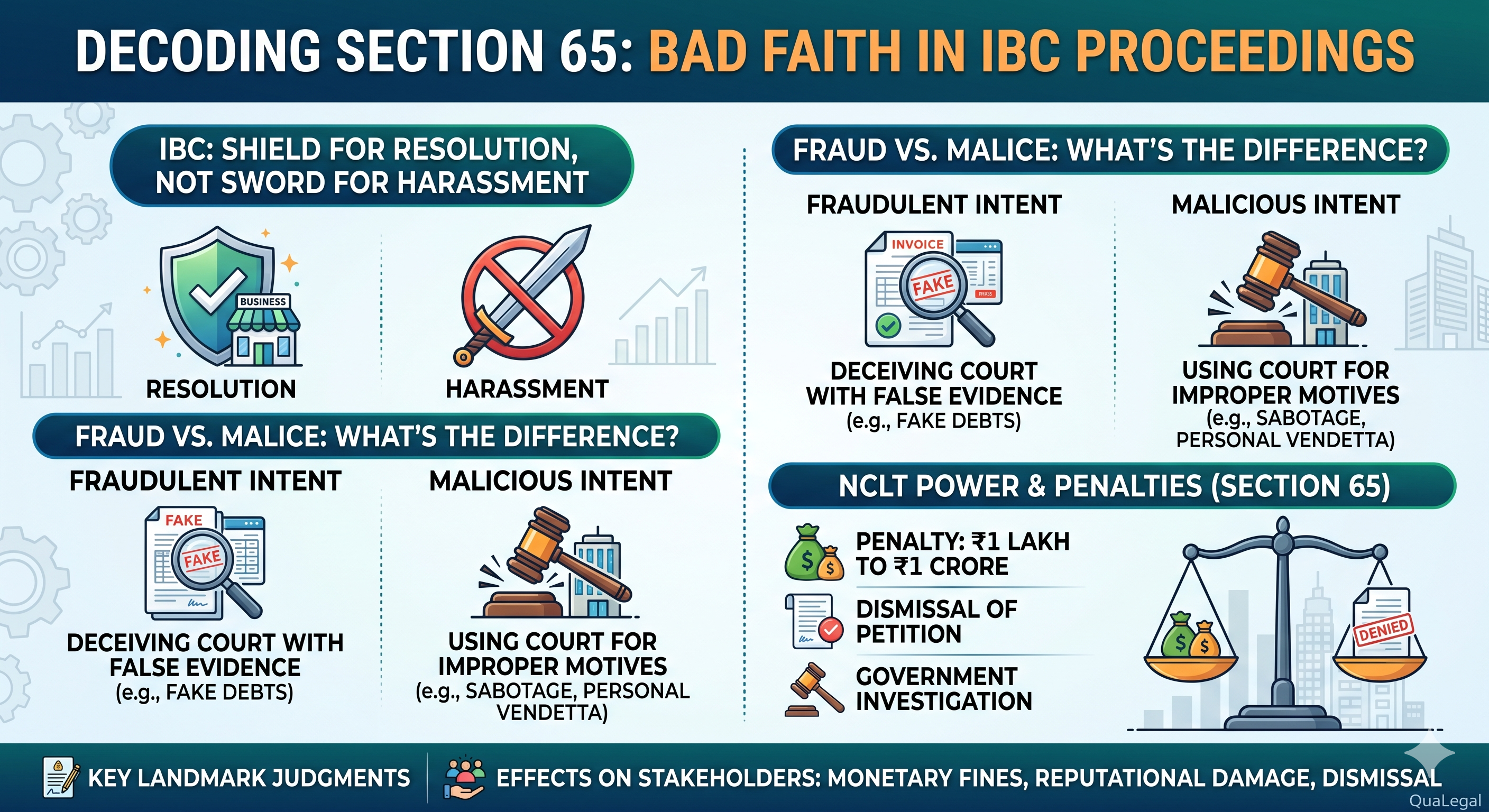
The Insolvency and Bankruptcy Code (IBC), 2016, was developed as an innovative law to simplify the handling of corporate distress. The code lays down the application, scope, procedure as well as the remedies available under the legal framework for individual as well as corporate financial distress. However, as true with most laws, even IBC can be used by entities and people in a wrong manner to take unfair advantage. It is here that Section 65(1) comes into play to serve as the safety mechanism of the IBC, making it clear that the insolvency resolution process should be used for the sole purpose of resolution of insolvency and not as a means to harass, pressurize or blackmail stakeholders.
Regardless of your standing as a business owner, creditor or a curious third-party, harnessing the importance of strict interpretation of Section 65(1) is the only way to learn the line between a right and a wrong legal recourse and court process abuse.
Section 65(1) of the IBC defines indulgent behaviour. The law is that Section 65(1) gives power to the National Company Law Tribunal (NCLT) to order punishment for a person who commences the insolvency proceedings in a fraudulent manner or with the intention for malice.
The IBC was sculpted to help companies to be financially resurrected (Resolution) or, in the event of that being impossible, to assist in the fair distribution of assets (Liquidation). If a company starts the proceedings for any reason such as to frighten the company to pay a disputed debt or to settle a personal vendetta, that person is acting against the purpose and ideology of the IBC. It is Section 65(1) which authorizes the NCLT to impose a prohibition to such proceedings and subsequently impose a fine against the plaintiff.
Legal Wording and Interpretation
Section 65 of the Insolvency and Bankruptcy Code states the following:
(1) If, any person initiates the insolvency resolution process or liquidation proceedings fraudulently or with malicious intent for any purpose other than for the resolution of insolvency, or liquidation, as the case may be, the Adjudicating Authority may impose upon such person a penalty which shall not be less than one lakh rupees, but may extend to one crore rupees.
(2) If, any person initiates voluntary liquidation proceedings with the intent to defraud any person, the Adjudicating Authority may impose upon such person a penalty which shall not be less than one lakh rupees but may extend to one crore rupees.
(3) if any person initiates a pre-packaged insolvency resolution process –
(a) Fraudulently or with malicious intent for any purpose other than for the resolution of insolvency; or
(b) with the intent to defraud any person,
the Adjudicating Authority may impose upon such person a penalty which shall not be less than one lakh rupees but may extend to one crore rupees.
What Is Meant by "Fraud" and "Malice"?
People may think that "fraud" and "malice" are the same type of unfairness and injustice, but in the legal system, they are not. To apply Section 65, one of the two must be proven and has a legal definition.
Fraudulent Intent
Typically, fraudulent intent is when someone deceives a person or Court by presenting false evidence. For example, a fraudulent act would be a creditor that submits false invoices in an effort to demonstrate a non-existent debt and convince a court that the company is in insolvency.
Malicious Intent
Malice is solely based on intent. Even though a debt may be truthful, the act may be malicious. If your intent is not constructive and the purpose is to damage a company by using the court to cause a freeze of the company's bank accounts or to force the company to pay a debt that is the subject of a pending civil suit, then your intent is malicious.
The primary and most prevalent incidence of Section 65 is a creditor using the IBC as a liquidation tool. The Supreme Court of India has consistently maintained that the IBC is not a debt recovery tool, and therefore must be avoided. If a company owes you a personal debt, and you desire to recover that debt through the IBC, you must not use it, unless the debtor company is "insolvent" and you qualify for a debtor rescue plan. Threatening a business with insolvency to settle a disputed debt crosses the line with Section 65.
Landmark Judgments: Understanding the Perspective of the Courts
To get a better perspective on the implementation of this section, we examine rulings from the NCLT and NCLAT.
In the case of Rakesh Taneja, the court observed serious allegations against the Corporate Debtor with respect to siphoning off money collected from Home Buyers, directing the Central Government to investigate the affairs of the Corporate Debtor given evidence that its affairs were conducted with intent to defraud creditors.2
In the Shiv Kumar Bansal case, the Court held that the initiation of proceedings under Section 7 was vitiated by fraudulent and malicious intent, constituting an abuse of the process of law. The Court recorded that where the very foundation of the CIRP is initiated on the basis of fraud and malice, it cannot be sustained in the eyes of law, and consequently nothing survives for further consideration.3
In Gopal Trading Company v. RP of Matrushri Fibres Pvt. Ltd. & Ors, the NCLAT imposed a fine of ₹10 lakhs on the operational creditor, finding that the insolvency resolution process was initiated with malicious intent — including to enjoy the moratorium from tax recovery and to buy time to prevent further proceedings by other authorities against the Corporate Debtor and its directors.4
The NCLT in Saivi Finance Private Limited v. AKJ Metals Private Limited also imposed a penalty of ₹10 lakhs under Section 65 of IBC, stating that the application filed under Section 7 was vitiated by fraudulent and malicious intent, constituting an abuse of the process of law.5
The Consequences: Penalties and Beyond
The results of bad faith petitioning carry systemic consequences of monetary, reputational, and functional damages:
Monetary Fines: The NCLT can impose fines for bad faith petition filings of up to ₹1 Crore. These fines are not reimbursements to the affected party — rather, they reimburse the State for the financial loss caused by the abuse of the court.
Functionality: The most tangible consequence is the dismissal of the insolvency petition, which would have devastating impacts on the petitioner's intended outcome.
Reputational Damages: All creditors stand to suffer from the loss of credibility in court. These reputational impacts are especially damning for large creditors and financial institutions.
How to Prove Malice or Fraud?
Proving what someone is "thinking" (intent) is the hardest part of a legal battle. However, the courts look at circumstantial evidence:
Pre-existing Disputes: If the creditor and debtor were already fighting in another court about the quality of goods or the amount owed before the IBC petition was filed, it suggests the IBC filing was an attempt to bypass the other court.
The Timing: If a petition is filed immediately after a company wins a major contract or is about to go public, it might suggest an intent to sabotage.
The Pressure of Settlement: If a creditor threatens the company by giving an ultimatum — either make payment or face NCLT insolvency proceedings — such circumstances suggest beyond doubt that the motive is recovery, not resolution.
Some Practical Advice for the Stakeholders
For the Creditors (The Applicants)
Before you get started under Section 7 (Financial Creditors) or Section 9 (Operational Creditors), ponder upon these questions:
Is there any bona fide default? Is there a pre-existing dispute as to this debt? Am I pursuing this to save the Company or just to get my payment?
For the Debtors (The Companies)
If you have been served with an insolvency notice which you consider to be unfair: record all the evidence that proves your debt is in dispute; show the sound financial health of your company to prove you are solvent; and if you can prove with documentary or circumstantial evidence that the petition is a travesty, move an application under Section 65 against the petitioner.
Conclusion: Putting the Balance Rightly
Section 65(1) of the IBC 2016 speaks volumes of the maturing nature of Indian Insolvency Law. "Ease of Doing Business" demands exit of the "Failed Company" from their business while the "Right to Do Business" demands protection against any "Vicious Litigation".
Section 65 is like a torch of justice — spotting and neutralising those who come with "unclean hands" while approaching the judiciary. IBC is to make business right, not to settle scores. Section 65 preserves it from the latter.
References
1. Section 65, The Insolvency and Bankruptcy Code, 2016
2. Mr. Rakesh Taneja & Ors. v. Wave Megacity Centre Pvt. Ltd. [2022 SCC OnLine NCLT 32634]
3. Shiv Kumar Bansal & Anr. v. Endless Services Pvt. Ltd [2025 SCC OnLine NCLT 7264]
4. Ravindra Kumar Goyal v. Gopal Trading Company [2025 SCC OnLine NCLT 6973]
5. Saivi Finance Private Limited v. AKJ Metals Private Limited [2025 SCC OnLine NCLT 9850]