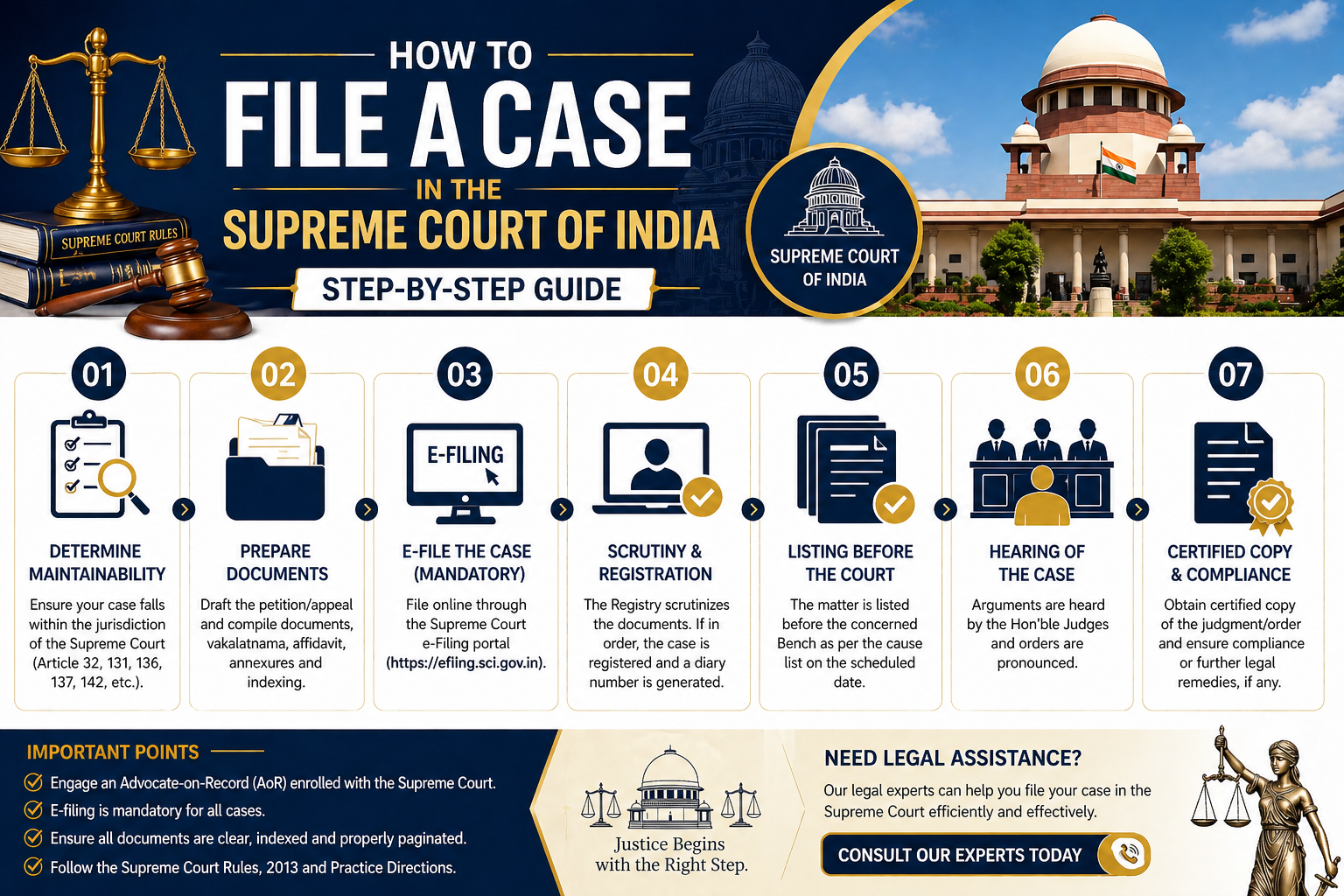
How to File a Case in the Supreme Court of India: A Step-by-Step Practical Guide
Introduction
Filing a case in the Supreme Court of India is not merely a procedural act, it constitutes a meticulously structured legal process that combines technical compliance, strategic evaluation, and precise drafting. As the apex court, the Supreme Court does not function as a routine forum of appeal. It steps in only when there are significant legal questions, constitutional matters, or cases of grave injustice.
The process is governed by the Supreme Court Rules, 2013, and requires strict adherence to format, limitation and documentation. Unlike lower courts, where procedural flexibility may exist, Supreme Court practice demands discipline, clarity, and legal precision.
This article outlines the thorough step by step procedure for filing a case in the Supreme Court, while also discussing the practical factors that affect the result at every phase.
Step 1: Determine Whether the Case is Maintainable
The initial and most crucial step is to determine if the case is appropriate for filing with the Supreme Court. Not every disagreement can be presented to the Court.
The Supreme Court is primarily concerned with:
- substantial questions of law
- constitutional interpretation
- conflicting judgments
- cases involving grave injustice
The majority of cases are submitted via a Special Leave Petition (SLP) under Article 136, which is completely discretionary. The Court is not obligated to consider every petition, and many cases are rejected at the initial stage.
Therefore, a careful assessment of maintainability is essential before proceeding further.
Step 2: Engage an Advocate-on-Record (AOR)
Filing a case in the Supreme Court can only be done through an Advocate-on-Record (AOR). This is a mandatory requirement under the Supreme Court Rules.
The AOR is responsible for:
- filing the petition
- ensuring compliance with procedural rules
- curing defects raised by the Registry
While senior advocates or arguing counsel may be engaged for arguments, the AOR remains the official representative for filing purposes.
Step 3: Collect and Prepare All Relevant Documents
Once the case is considered fit for filing, the next step is to gather all necessary documents. This stage is crucial since the effectiveness of the petition relies on adequate documentation.
Typically required documents include:
- certified copy of the impugned judgment
- orders of lower courts
- pleadings and evidence
- supporting documents
All documents must be in English. If any document is in a regional language, a certified translation must be provided.
Step 4: Draft the Petition with Precision
Drafting is the most critical stage in Supreme Court filing. A well-drafted petition can determine whether the case is admitted or dismissed.
A Supreme Court petition generally includes:
- Synopsis and List of Dates – a concise overview of the case
- Facts of the Case – presented clearly and chronologically
- Questions of Law – the core of the petition
- Grounds of Challenge – legal reasons for challenging the judgment
- Prayer Clause – relief sought
The emphasis must always be on questions of law rather than facts. The Supreme Court is not concerned with re-evaluating evidence but with correcting legal errors.
Step 5: Prepare Supporting Documents and Affidavits
The petition must be accompanied by supporting documents, including:
- Vakalatnama authorising the AOR
- Affidavit verifying the contents of the petition
- Annexures (documents relied upon)
- Court fees as prescribed
Step 6: File the Petition Before the Supreme Court Registry
Once the petition is complete, it is filed before the Registry of the Supreme Court.
Filing can be done through:
- physical filing at the Court
- e-filing system, which has been increasingly adopted
The Registry assigns a diary number to the case, marking its entry into the Court system.
Step 7: Scrutiny and Removal of Defects
After filing, the Registry scrutinises the petition to check compliance with procedural requirements.
Common issues include:
- formatting errors
- missing documents
- incorrect pagination
- defects in affidavits
Step 8: Listing for Admission
Once cleared, the petition is listed before the Court for admission. The Court decides whether to issue notice or dismiss the petition.
Step 9: Issuance of Notice and Filing of Replies
If admitted, the respondent files a counter affidavit and the petitioner may file a rejoinder.
Step 10: Final Hearing and Judgment
The Court hears arguments and may uphold, modify, or set aside the judgment.
Important Consideration: Limitation Period
- 90 days from the date of judgment (SLP)
- 60 days if High Court refuses certificate
Practical Insights: What Really Matters
- The Court focuses on legal issues, not factual disputes
- Drafting quality plays a decisive role
- The admission stage is crucial
- Not every case should be taken to the Supreme Court
Conclusion
Initiating a case in the Supreme Court of India is a specialized procedure that necessitates a combination of legal understanding, adherence to protocols, and tactical planning. Governed by the Supreme Court Rules, 2013, the process demands precision at every stage from evaluating the case to drafting, filing, and final hearing.
The Supreme Court is not merely a forum of appeal, it is a court of significant constitutional value. Successfully approaching it requires presenting a case that raises significant legal issues and justifies the Court’s intervention.