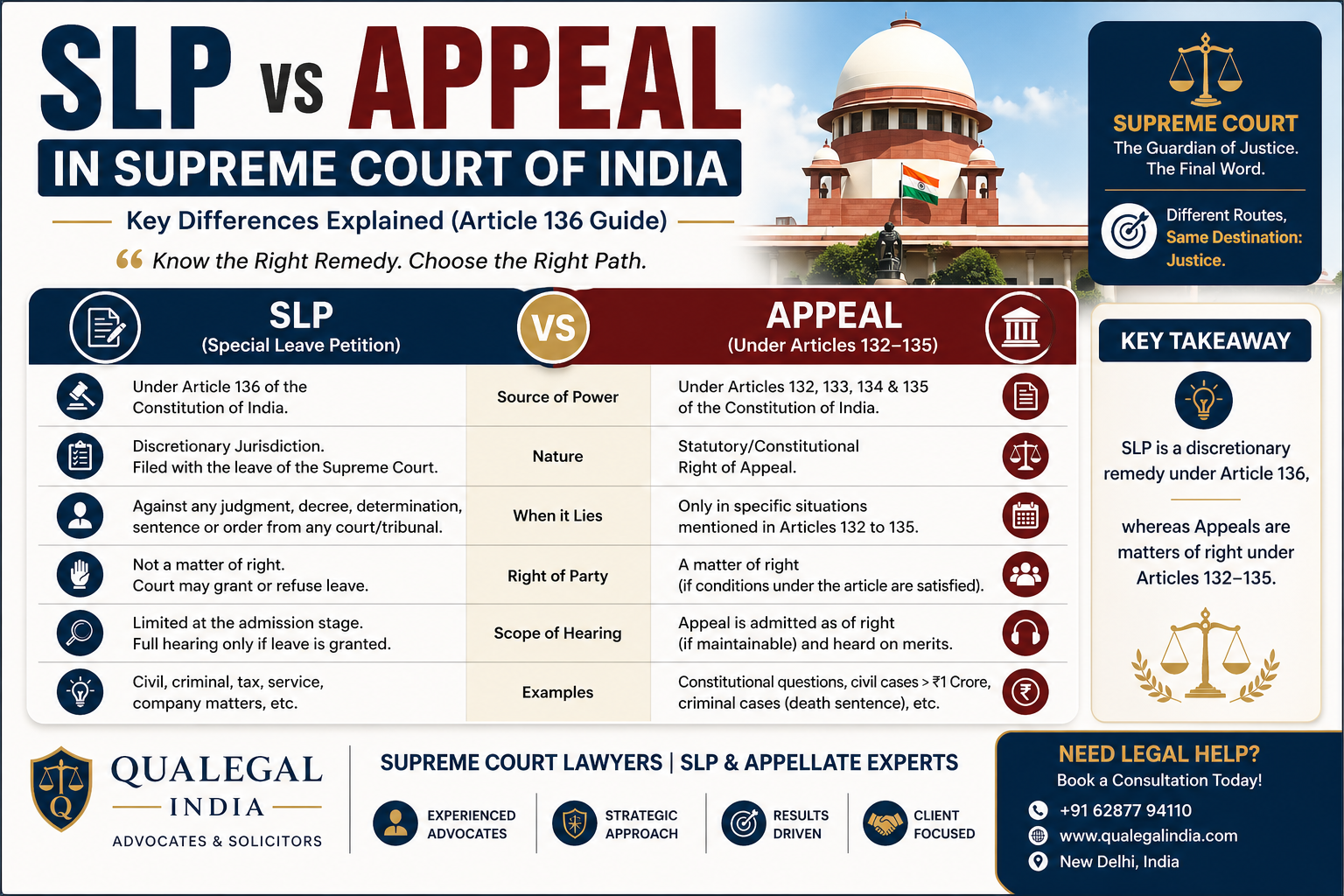
SLP v Appeal : Supreme Court’s Appellate Jurisdiction
The appellate jurisdiction of the Supreme Court of India forms the core of its judicial function. It reflects a carefully layered constitutional design. In its simplest sense, appellate jurisdiction refers to the authority of the Court to review and correct decisions of subordinate courts and tribunals. This must be understood in contrast with its original jurisdiction under Article 131 of the Constitution of India, its writ jurisdiction under Article 32 of the Constitution of India, and its advisory role under Article 143 of the Constitution of India.
What is striking is that the Constitution does not treat appellate jurisdiction as a single, continuous power. Instead, it divides it between Articles 132–135 of the Constitution of India and Article 136 of the Constitution of India. This separation reflects a deliberate choice. One pathway is structured, filtered, and conditional. The other is wide, discretionary, and residuary. Together, they create a balance between predictability and flexibility.
Appeals under Articles 132–135: A Structured Right
Appeals under Articles 132 to 135 are often described as appeals “as of right”, but this phrase can mislead if taken literally. The right is not automatic. It arises only upon the grant of a certificate of fitness by the High Court, which acts as a constitutional filter. The High Court must be satisfied that the case involves a substantial question of law, or one that requires consideration by the Supreme Court.
Article 132 of the Constitution of India is concerned with substantial questions relating to the interpretation of the Constitution. Its role is to ensure uniformity in constitutional law across jurisdictions across states and within the union. Article 133 of the Constitution of India governs civil appeals and, after amendment, focuses on questions of general legal importance rather than pecuniary thresholds. Article 134 of the Constitution of India is narrower, permitting criminal appeals as of right only in specific and serious circumstances, particularly where severe penalties are involved. Article 135 of the Constitution of India preserves the appellate jurisdiction inherited from the Federal Court.
The requirement of certification gives the High Court a pivotal role in shaping the Supreme Court’s docket. It is not a mere procedural step. It is a substantive judicial determination that the case meets a constitutional threshold.
This mechanism serves two purposes. First, it prevents routine or fact-heavy disputes from reaching the Supreme Court. Second, it ensures that only cases involving substantial questions of law or broad legal importance are escalated. In this sense, appeals under Articles 132 to 135 represent a controlled and disciplined route to the apex court.
The practical implication of this framework is clear. The High Court determines whether a case deserves to travel upward. If certification is granted, the Supreme Court must ordinarily hear the matter. If it is refused, the litigant must seek recourse elsewhere, most often under Article 136.
Article 136: The Extraordinary Power of Special Leave
In contrast, Article 136 of the Constitution of India operates outside this structured framework. It empowers the Supreme Court to grant special leave to appeal from virtually any order of any court or tribunal in India, subject to limited statutory exclusions.
The provision is remarkable for its breadth. It is not confined to final judgments. It is not restricted by subject matter. It extends across the entire judicial and quasi-judicial spectrum. For this reason, it is often described as residuary or plenary. Yet, this wide amplitude is tempered by a single controlling idea: discretion.
The Court is not bound to entertain every petition placed before it. On the contrary, it routinely declines to interfere, often at the threshold stage. Over time, it has evolved guiding principles. Intervention is typically reserved for cases involving manifest injustice, perversity in findings, serious procedural irregularity, or questions of law of public importance. Across multiple judgements, the Court made it clear that Article 136 is not meant to function as a regular avenue of appeal. Later decisions have reaffirmed that it is an extraordinary jurisdiction, to be exercised sparingly.
From Special Leave to Appeal: The Moment of Transformation
A distinctive feature of Article 136 lies in what happens after leave is granted. The Petition filed under Article 136 seeks special leave of the Hon’ble Court in order to bring to surface that the petitioner has suffered grave injustice at the hands of the Respondent(s) along with establishing that the matter at hand is worthy of being heard by the Apex Court. One battle is to fight for the Court’s attention at the very first instance after filing the petition, to ‘issue notice’ to the Respondents- and establish that there is injustice borne by the Petitioner. The second battle is to secure the special leave of the Hon’ble Court once the respondents are notified, pleadings complete and arguments heard and establish that the grave injustice borne by the Petitioner is worthy of reconsideration by the Hon’ble Court.
Until ‘leave is granted’, the proceeding remains a petition seeking permission to appeal. Once leave is granted, however, the character of the matter changes fundamentally. It becomes a regular appeal before the Supreme Court.
This transformation carries important consequences. The Court is no longer confined to deciding whether interference is warranted. It may examine the matter in full, and the doctrine of merger applies, with the judgment of the High Court merging into that of the Supreme Court. The proceeding, in substance, aligns itself with a conventional appellate process.
Appeals versus SLP: A Jurisprudential Distinction
The difference between appeals under Articles 132 to 135 and proceedings under Article 136 is not merely procedural. It is conceptual.
Appeals under Articles 132 to 135 are rooted in a conditional right, triggered upon certification by the High Court. They represent a structured pathway designed to address substantial questions of law. Article 136, in contrast, is not a matter of right at all. It is a discretionary remedy, invoked only when the Supreme Court considers it necessary to prevent injustice.
The scope of interference also differs. In certificate-based appeals, the Court is generally guided by the questions identified at the stage of certification. Under Article 136, especially before the grant of leave, the Court acts as a sentinel, intervening only in exceptional cases. After leave is granted, however, its powers expand, and it may examine the entire record.
A related question arises where a litigant bypasses the certificate route and approaches the Court directly under Article 136. While this is not barred, the Court often takes into account whether alternate efficacious statutory remedies were pursued. The existence of an alternative pathway may weigh against the exercise of discretion, though it does not conclusively determine the outcome.
Procedure, Practice, and Strategic Considerations
From a practitioner’s standpoint, the distinction has tangible consequences. A certificate appeal follows a relatively defined path once the High Court grants certification. An SLP, on the other hand, demands careful drafting, precise articulation of questions of law, and strict compliance with limitation requirements.
At the admission stage, the fate of an SLP is often decided. The Court may dismiss it summarily, issue notice, or grant interim relief. Delay in filing may be condoned, but only upon sufficient cause being shown, and the Court has shown increasing discipline in this regard. The jurisprudence surrounding Article 136 reflects both its strength and its restraint.
Conclusion
The architecture of appellate jurisdiction in the Supreme Court reveals a careful balance between structure and discretion. Articles 132 to 135 create a disciplined system of access, filtered through the High Court and anchored in substantial questions of law. Article 136 stands apart as a wide, discretionary power, enabling the Court to intervene where the ordinary processes of law fall short.
For practitioners, the distinction is not academic. It shapes litigation strategy, determines procedural choices, and often decides whether the Supreme Court will engage with the matter at all. The Constitution, in separating these pathways, ensures that the Court remains both a court of law and a court of justice.