By Advocate Garima Bhadoria
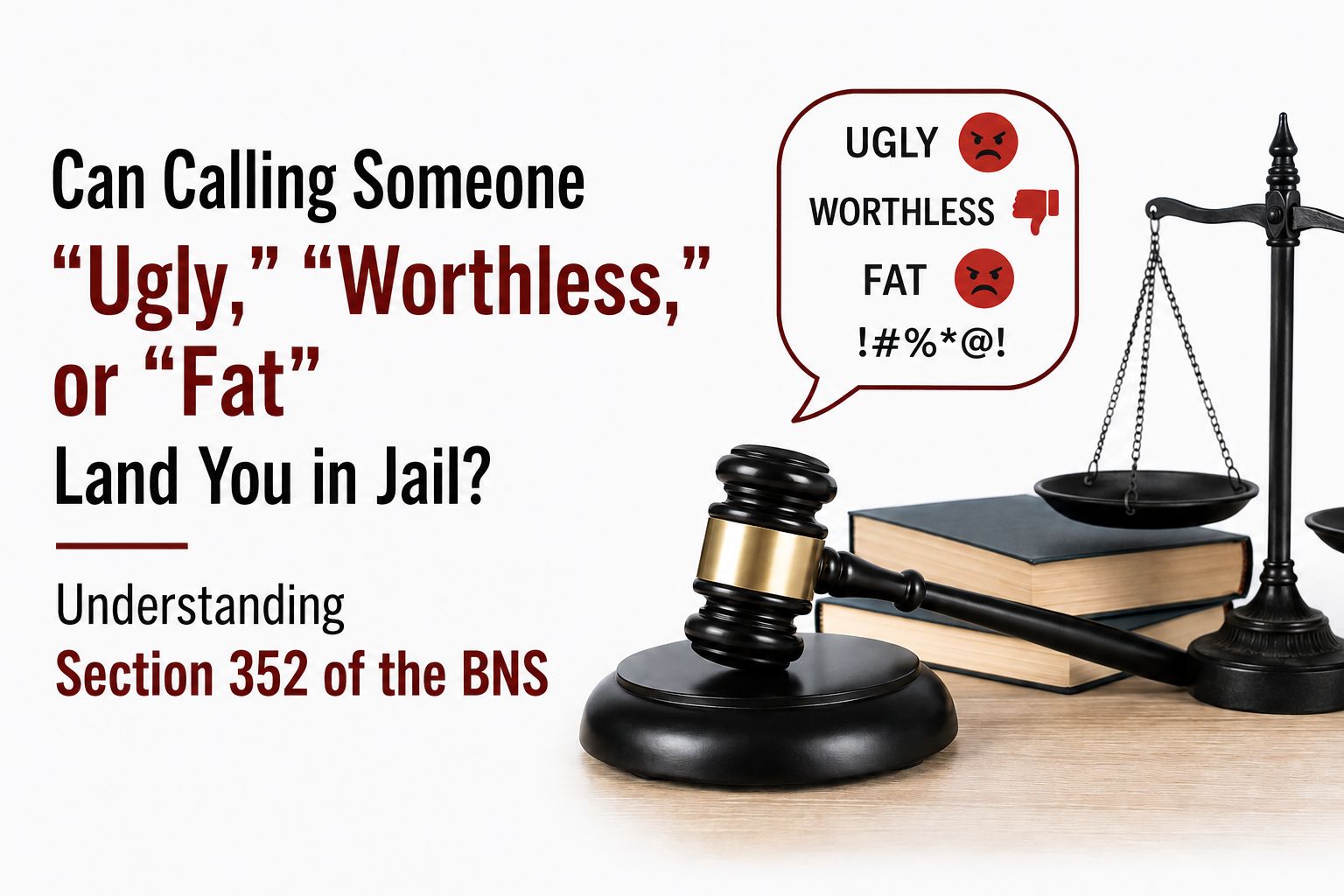
A viral social media post has claimed that insulting someone by referring to their skin colour, height, or personal worth or any other such remarks can invite criminal liability under the new Bharatiya Nyaya Sanhita, 2023. The claim has sparked genuine debate over what this means. One wonders, what if a harmless roast between friends ends up with one behind bars? Lets break it down and see what section 352 of BNS is all about.
What does Section 352 of the BNS Actually Say?
"Whoever intentionally insults in any manner, and thereby gives provocation to any person, intending or knowing it to be likely that such provocation will cause him to break the public peace, or to commit any other offence, shall be punished with imprisonment of either description for a term which may extend to two years, or with fine, or with both."
The provision applies to all persons regardless of who delivers or receives the insult. The maximum punishment under the section is of two years.
What the Courts Have Said Under BNS?
Since the BNS came into force, courts have already begun interpreting Section 352 in the context of online speech and political expression.
In Nalla Balu v. State of Telangana, the petitioner had posted tweets on the platform X (formerly Twitter) criticising the Chief Minister of Telangana. Three FIRs were registered against him, Hon’ble High Court of Telangana held that political criticism, however harsh or offensive, does not attract Section 352 BNS unless there exists prima facie material disclosing an imminent threat to public order. The Court further laid down binding operational guidelines, directing that no case for intentional insult under Section 352 shall be registered "unless there exists prima facie material disclosing incitement to violence, hatred, or public disorder."2 This is now the clearest judicial articulation of the threshold under Section 352 BNS, and it is a high one.
The Telangana HC's reasoning in Nalla Balu case is directly instructive here. the character of the speech matters, but so does the context in which it is made. An offensive comment in a private chat, a derogatory message in a closed group, or an insult exchanged in a personal argument, however morally indefensible will not ordinarily clear the threshold of Section 352 without a live nexus to potential public disorder.
Any honest analysis of Section 352 must engage with Article 19(1)(a) of the Constitution, which guarantees every citizen the right to freedom of speech and expression. Criminal law cannot be deployed to suppress speech that is merely offensive, unpopular, or hurtful it can only restrict speech that poses a real and present danger to public order. The Telangana HC in Nalla Balu case explicitly applied this principle to BNS.
The Supreme Court in Shreya Singhal v. Union of India3, a landmark ruling on the constitutional limits of criminal speech law held that mere annoyance or offence caused to others is not a constitutionally permissible ground to restrict speech. Only speech that amounts to incitement to imminent violence or disorder can attract criminal sanction. Section 352 BNS, read in this light, must be interpreted narrowly and applied with restraint.
A Comparative Lens: How Other Jurisdictions Treat the Same Problem
a. The Predecessor: Section 504, Indian Penal Code, 1860- Section 352 BNS is a direct descendent of Section 504 IPC, which was itself drawn from the draft Indian Penal Code prepared by Lord Macaulay in 1837 which was modelled substantially on English common law. The language of Section 504 IPC and Section 352 BNS is nearly identical. What BNS has done is modernise the framing slightly and reorganise the Code, but the substantive law is unchanged. Decades of judicial interpretation under Section 504 IPC therefore remain fully relevant to understanding Section 352 BNS, a point acknowledged by the Telangana High Court in Nalla Balu (2025) when it applied IPC-era principles to the BNS provision without hesitation.
b. United Kingdom: Public Order Act, 1986, Sections 4A and 5- England and Wales addresses intentional insult through two provisions of the Public Order Act, 1986. Section 5 makes it an offence to use threatening or abusive words or behaviour, or disorderly conduct, within the hearing or sight of a person likely to be caused harassment, alarm or distress, a broader and lower threshold than Section 352 BNS. More closely parallel is Section 4A, which criminalises intentional conduct using threatening, abusive or insulting words or behaviour that actually causes harassment, alarm or distress. The punishment under Section 4A is imprisonment up to six months.3 This is significantly lower than India's two-year maximum and reflects a different legislative calibration of the offence. Importantly, Parliament amended the Public Order Act in 2014 to remove the word "insulting" from Section 55, following sustained debate about the tension between the provision and freedom of expression. This legislative retreat is instructive, even in the UK, the trend has been towards narrowing, not expanding, the scope of the offence.
c. Canada: Section 175, Criminal Code of Canada- Canada addresses the same conduct through Section 175(1) of the Criminal Code, which makes it an offence to cause a disturbance in or near a public place by, among other things, using insulting or obscene language.6 The parallel with Section 352 BNS is apparent, but with two notable distinctions. First, Section 175 is explicitly limited to public spaces. Private conduct is entirely excluded. Second, the Supreme Court of Canada in R. v. Lohnes7, a landmark ruling on the provision held that the offence requires an "externally manifested disturbance of the public peace"8. The conduct must go beyond causing annoyance or emotional upset and must actually interfere with ordinary public enjoyment of the space. This is remarkably consonant with the threshold laid down under Section 352 BNS by the Telangana HC in Nalla Balu. The Canadian provision is a summary conviction offence with lighter penalties, reflecting the legislature's view that such conduct, while criminal, sits at the lower end of the spectrum.
d. Australia: Coleman v. Power and Public Nuisance Law- Australia does not have a single national equivalent to Section 352 BNS. Under section 7(1)(d) of Queensland’s Vagrants, Gaming and Other Offences Act, it was an offence to use threatening, abusive or insulting words to a person in a public place or where they could be heard in a public place but this has since been repealed. However, several states criminalise offensive language and conduct in public spaces. The most significant judicial contribution came from the High Court of Australia in Coleman v. Power (2004) 220 CLR 19, where the Court held that merely insulting a police officer or indeed, directing an insult at any person does not constitute a criminal offence unless the conduct is likely to result in a breach of the peace or amount to victimisation. This reasoning maps almost precisely onto the Indian constitutional framework: the offence is triggered by the public order consequence, not by the subjective hurt of the target.
What emerges from the above is that whether one looks to India's BNS, England's Public Order Act, Canada's Criminal Code, or Australia's common law, the same principle runs through all, an insult becomes a criminal matter only when it threatens to fracture public peace, not merely when it wounds private feelings.
Practical Takeaway
Section 352 BNS is not a statute against rudeness. It is a public order provision, designed for situations where a deliberate insult is weaponised to provoke a breach of peace, not for every cutting remark made in anger, jest, or cruelty. It is not a "politeness statute" that criminalises every offensive remark. It is a public order provision designed to prevent insults from escalating into violence or disorder.
References:-
1. Section 352, Bhartiya Nyaya Sanhita, 2023
2. Nalla Balu Versus State of Telangana [2025 SCC OnLine TS 855]
3. Shreya Singhal v. Union of India, [(2015) 5 SCC 1]
4. Public Order Act 1986, Section 4 and 5.
5.https://www.legislation.gov.uk/ukpga/1986/64/section/5#commentary-key-f5820f6be880330067a694c379b4e178
6. Criminal Code of Canada, Section 175.
7. R. v. Lohnes, [1992] 1 SCR 167
8. ibid
9. Patrick John Coleman V Brendan Jason Power, Adam Carnes and Attorney-General (Queensland) [(2004) 220 CLR 1]